A Dairy Farmer’s Thoughts on the TPP

Now that I have had some time to let the recent announcements about how the TPP will affect the dairy industry sink in, here is my reaction:

First of all, I’d like to extend my thanks to Dairy Farmers of Canada, and especially to DFC President Wally Smith, for their untiring work representing Canadian dairy farmers’ best interests both in Hawaii in July, and in Atlanta and Ottawa during this round of negotiations. I know that they did their utmost to present our industry’s concerns and reservations about the trade agreement and lobbied unceasingly for the preservation of our supply managed system. And their hard work paid off! Remember, just a few months ago, supply management as a system seemed to be on the negotiating table, and just last week rumours suggested that up to 10% market access was being considered. Thankfully, neither of these two scenarios came to fruition.

So what does the TPP mean for our dairy industry? Well, I don’t pretend to be an expert, but I’d like to take some time to share my thoughts.

Under the TPP agreement, our trading partners now have access to an additional 3.25% of our dairy market, tariff-free, based on  2016’s milk production. Consequently, this milk will not be produced in Canada, and will result lost revenues for dairy farmers as well as a reduction in our GDP and tax revenue. Our government negotiators obviously thought this was an appropriate and acceptable price to pay to participate in the TPP. And of course, there are benefits to being involved in this trade agreement, also for other agriculture sectors such as beef, canola, barley, pork, wine, etc, who will all benefit in some manner from this trade deal. But while we are happy for their good fortune, this does not detract from the reality facing our industry: reduced demand for our Canadian milk which will be displaced by foreign imports. As a result, dairy farmers’ income will be reduced. The government has announced that it will be implementing new programs to help dairy farmers through this situation. While what this will exactly entail remains to be seen and/or expounded upon, here is the official announcement:
“The Government of Canada announced new programs for dairy, poultry and egg producers and processors to assist them throughout the implementation of TPP and the Canada and European Union Comprehensive Economic and Trade Agreement (CETA):
•The Income Guarantee Program will provide 100% income protection to dairy, poultry and egg producers for a full 10 years from the day TPP comes into force. Income support assistance will continue on a tapered basis for an additional five years, for a total of 15 years.
•The Quota Value Guarantee Program will protect producers against reduction in quota value when the quota is sold following the implementation of TPP. The program will be in place for 10 years.
•The Processor Modernization Program will provide processors in the supply-managed value chain with support to further advance their competitiveness and growth.
•The Market Development Initiative will assist supply-managed groups to promote and market their top-quality products.”

Dairy Farmers of Canada is still assessing exactly what these programs mean, and I’m sure they’ll be forthcoming with that information as it becomes available. DFC President Wally Smith said that he appreciates the government support which has “lessened the burden by announcing mitigation measures and what seems to be a fair compensation package, to minimize the impact on Canadian dairy farmers and make up for cutting growth in the domestic market.” We certainly would rather have emerged from these negotiations without having had to sacrifice any market access, but we’re still thankful that our supply management system has remained intact.

While I am grateful that our government will try to ensure our industry’s survival with these assistance programs, it galls me to think that one of the biggest points of pride in our industry is falling: these programs are likely to be viewed as subsidies. We can no longer pride ourselves on being able to produce our milk without government support. And I know that this is beyond our control, but I can’t help but feel that this is somehow represents a decline in our industry’s integrity. If only national food sovereignty was more important to our government, because if it was, we wouldn’t be in this position at all.

For our consumers:

THANK YOU so very much for your support and encouragement during the last few months. It’s wonderful to know that our work is appreciated and that you understand the benefits of keeping the milk in our grocery stores produced by Canadians, for Canadians. We’re grateful for the actions you took on our behalf: sending letters to our government in support of Canadian dairy, contacting your government representatives directly, and sharing our concerns with your friends via social media. I believe that this outcome is a result of the public outcry at the suggestion of opening our markets to huge amounts of foreign product, and that without your support and participation in our campaign to preserve supply management the final result would have been far more detrimental to our dairy farmers.

A few months ago, you showed in an overwhelming manner that you support milk produced by Canadian farmers. In a poll conducted by Environics Research, 89 per cent of you said it was important, or very important, that the milk products you use come from Canadian farmers! We’re so glad you are happy with the product we produce, and we hope that we can continue to count on your support. Thankfully, it is still possible for you to source Canadian dairy products and thus support Canadian dairy farmers. Dairy products that are produced with only Canadian milk are labeled with the 100% Canadian Milk logo of the little blue cow. If your favourite dairy items don’t have this label, contact the processor to ask if it produced with only Canadian milk and ask them to label it as such. Remember, purchasing products made from 100% Canadian milk means that the benefits of that sale remain in Canada: it benefits the farmer and the whole economy. Our farmers rely on many other Canadian businesses to produce milk: feed companies, equipment companies, banks, transportation companies, etc. and so by purchasing Canadian milk, you help to keep these companies in business as well, which bolsters the entire Canadian economy. By buying Canadian, we all win – consumers and farmers alike. What’s not to like about that?

I believe that our industry will survive this hurdle. It may not be easy, and it likely won’t be pretty. But now more than ever we need to remain strong and united. We must continue to supply our top-quality milk, produced according to the highest quality and animal welfare standards IN THE WORLD. And we will continue to do this because, really, could we do otherwise? When dairying is in your blood, there simply is no alternative. It’s not what we DO, but it’s who we ARE. We ARE Canadian dairy. And we’re immensely proud of that. I know that you will join me in continuing to fight to keep Canadian dairy farming viable for our consumers and, just as importantly, for the next generation, so that they, too, can become what they dream to be: dairy farmers of Canada.

Supply management: Better than Ever for Canadian Farmers, the Economy and our Consumers

I support supply management. Period. As a member of a Canadian dairy farming family, proudly producing top quality milk for my fellow citizens, I know that supply management’s demise would mean the end of the dairy life that I know and love. Recent articles from various news outlets as well as a newly released study have brought these feeling to the foreground once again. In my opinion, the media’s discussion about the future of the Canadian dairy industry is sorely lacking any input from Canadian dairy farmers themselves. I’d like to add my voice, a dairy famer’s voice, to the discussion as well. In all likelihood, you’ve read one or more opinion pieces recently speculating about the fate of supply management as the Trans Pacific Partnership negotiations continue. According to various sources, Canada’s participation in these trade talks depends on our willingness to dismantle our supply managed poultry, egg, and dairy sectors. Looking north, the US sees Canada as a veritable treasure trove of untapped export opportunities. In the wake of falling global milk prices, increased competition from newly emerging dairy powerhouses like New Zealand, and lost markets due to the Russian embargo,  a new dairy export market would inject some much needed income into the US dairy industry. As though throwing a dog a bone, supporters of the TPP claim that Canada will also be able to export dairy products south of the line, but, in my opinion, this half-hearted benevolence does little to mask their true intent: flooding the Canadian market with mass produced milk. Additionally, a  recent article in the Globe and Mail falsely accused Canadian dairy farmers of producing too much milk and that milk dumping was occurring as a result, and used this standpoint as a grandstand to air anti-supply management sentiments. This article has since been soundly discredited, here, here and here, but the ideology behind those sentiments remains, and is extremely worrisome to my fellow dairy farmers and myself.  Here’s why:

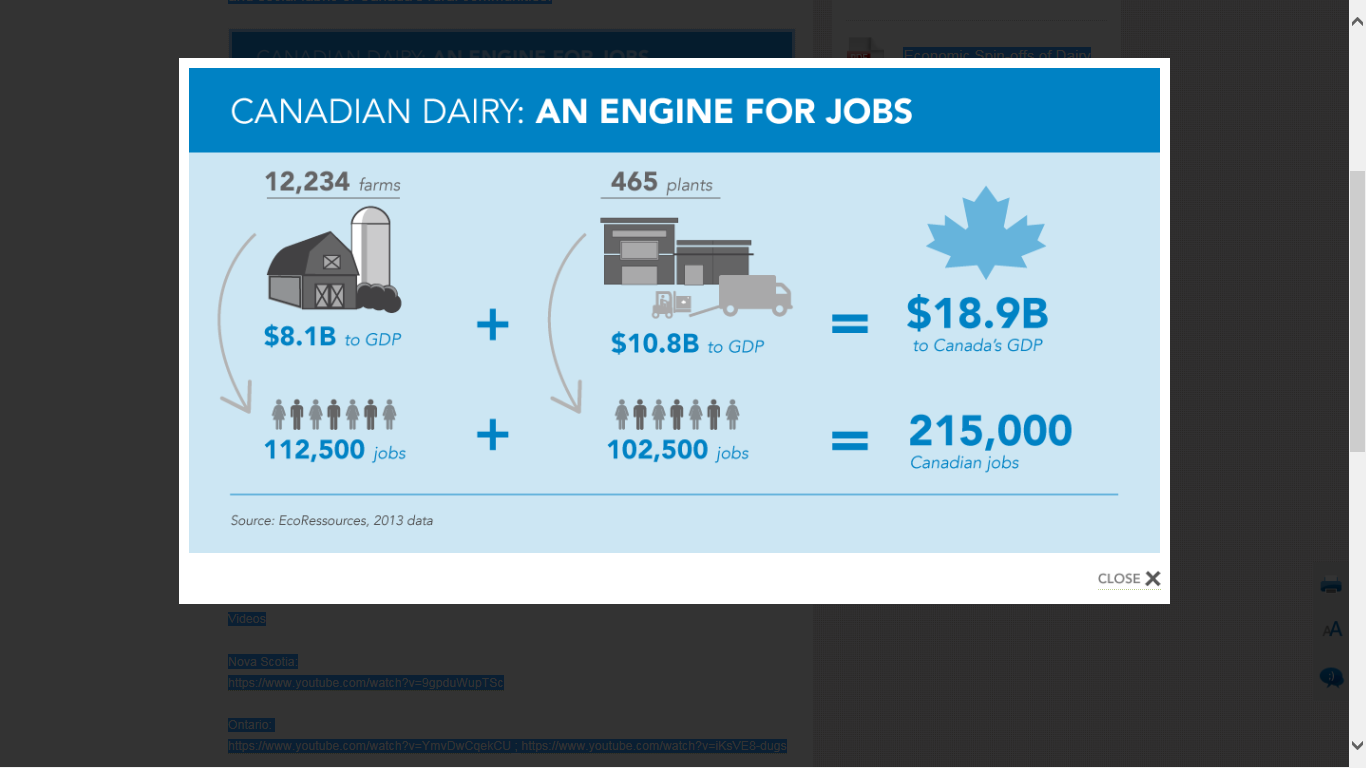
What does Canada actually stand to lose if supply management crumbles? A study commissioned by the Dairy Farmers of Canada shows just that. This study “affirms the significance of the economic impact of the dairy sector in Canada. Conducted by EcoRessources, the study, entitled “The Economic Impacts of the Dairy Industry in 2013”, is third in a series which tracks the changes and impact of the sector over the years, beginning in 2009.” Highlights of this year’s study point to :

  • Local, provincial and federal tax revenue produced by the dairy sector: $6.3 Billion in 2013
  • Growth in Gross Domestic Product (GDP) output by $3.7 Billion in four years, to 18.9 billion in 2013
  • 215 000 jobs maintained by the industry
  • More milked shipped: 7.8 billion litres in 2013, up from 7.6 billion litres in 2009.
  • Less than 10% of Canadians’ disposable income is spent on food, one of the lowest in the world (1.03% on dairy).
Dairy Industry Statistics

Dairy Industry Statistics

In addition to this study that highlights the dairy sector’s vibrancy, viability and important contributions to the Canadian economy, recent analyses have also shown increased growth in the dairy industry due to Canadians’ higher demand for dairy products. The retail sales of cream (+5.5%), butter (+4.4%), cheese (+3.2%), and organic milk (+15%) registered quite remarkable growth rates over the past year. Dairy farmers have been asked to produce more milk than last year – 8% more in the past year here in BC alone! – to keep up with this increased demand.

The risk Canada runs by dismantling supply management is this: we could lose many of the above mentioned contributions and more than that, we would stand to lose what we value the most, a safe, secure supply of milk, produced to the highest quality standards that Canadian consumers have come to rely on. The ultimate sacrifice if supply management is eliminated would be our Canadian family farms. With an average size of 77 milking cows, we would have a very difficult time competing with the glut of foreign-government-subsidized milk flooding in over an opened border, most produced by mega dairies. This would likely mean the end of the dairy industry as we know it. Canada’s small, family run, environmentally conscious, local farms would likely be replaced by what experts call CAFOs – confined animal feeding operations. With CAFOs come a number of environmental risks, and they require special legislation to operate, but they can produce milk at a lower cost. I am quite active on social media, sharing our daily farm experiences, and I have had many conversations with consumers who are concerned about the environmental risks and animal welfare concerns that tend to be attached to CAFOs. The current situation in California is a prime example of this: farmers there are paying a huge price for over-concentrated farming and the subsequent consumer backlash against agriculture. Would Canadian consumers really appreciate our family owned and operated dairies turning into massive conglomerates?  I have my doubts…

IMG_2353

Our family owned and operated 80 cow dairy farm. Will it be a casualty if supply management falls?

Claims that Canada could become a big player in the export game have little standing. Since deregulation in Australia in 2001, exports initially grew for a short period of time, but have since dropped rather dramatically, from 6.1 million tonnes in 2002 to 2.9 million tonnes in 2011. From this we can see that more market access does not necessarily mean more industry growth. And we’re not comparing apples to apples here! Australia’s climate allows their dairy industry to rely on a cheaper, pasture based system, which is unfeasible due to Canada’s much harsher climate. Our cost of production due to the need to store and purchase feed and house our animals for extended periods of time is therefore higher, and would lead to challenges in competing on the world market. And of course, we cannot forget that presently there is an excess of milk globally, contributing to very low milk prices. What little Canadian farmers could export after deregulation would likely not have very much monetary value relative to the cost of production. Another interesting recent development, to me, is that the oft-mentioned comparisons of prices of dairy products for consumers in the US and Canada seem to have faded into the background. The lower Canadian dollar has resulted in the price difference shrinking considerably. Even with the government subsidized milk prices in the grocery stores, US milk prices are very close to, and sometimes even higher than, Canadian prices. Meanwhile, prices paid to US farmers have dropped in the last few months to below the cost of production (according to an American dairy friend). Dismantling supply management would likely not result in a decrease in consumer pricing, but could result in an increase in taxes to fund government subsidies if the cost of producing milk in Canada is not covered by farm gate prices.

Price of milk in Florida vs Prince Edward Island

Price of milk in Florida vs Prince Edward Island (photo and tweet credit:Randall Affleck)

So what can you, my fellow dairy farmers and consumers, do to help others understand the value of our current system? Talk about why you support the supply managed system, write about it, or, better yet, contact your local member of parliament. In an election year, our voices are more influential than ever and are more likely to be heard. MPs need your support to win their seats come November, and they need to know what is important to their constituents. With such a significant contribution to our country’s economic vitality, we have the obligation to make our voices heard; our voices matter. And our voice is this: We support supply management… because it works! It works for farmers, for consumers and for our country. Stand firm, Canada!

Is Organic Farming Anti-Science?

I’m an organic dairy farmer, and this question–Is organic farming anti-science–has been weighing on my mind recently. Said another way, many people question whether organic farming is as advanced as conventional farming. This is an issue close to my heart as I’m a former conventional farmer.

Speaking for myself, and I believe for all the organic farmers who I know, I’m constantly on the lookout to improve our operation with new or improved farming techniques, often spending time online and on social media researching different methods of agriculture and interacting with and learning from other farmers and farming organizations, and not just those that support organic farming.

For the past several months, especially since I have become more active on social media, I have read multiple assumptions that purport to show that farming organically means that scientific knowledge and research is thrown out the window. I’ve also heard opinions that organic farming is not as innovative, efficient, or sustainable as conventional farming. In addition to this, I have seen consumers that choose organic products ridiculed as uninformed and unrealistic for buying into the latest scam or “woo” put forward by organic farmers and “Big Organic” and, subsequently, supermarkets’ motives are questioned when they source foods (supposedly) produced in a manner not supported by scientific research to supply these consumers.

Some recent examples

Some recent examples

Now, as an organic farmer, allow me to try to explain why I believe that these assumptions are neither accurate nor warranted. Here’s why:

When I take stock of our farm practices on our transitional organic dairy farm, I find that I can say with emphasis that I firmly believe that organic farming is just as science based and as innovative as conventional farming, especially in these three areas: sustainability, animal welfare, and technology. *Disclaimer: this is not an in-depth look at organic versus conventional farming, but rather a short, superficial analysis of how organic farming also utilizes science and technology. Technology and Scientific Research: Organic farms utilize much of the same technology that conventional farmers employ. Precision cropping equipment and high tech field mapping in crops are used by conventional and organic farmers alike.  Sometimes, organic farmers use different, but still advanced, technology, such as the new piece of equipment I came across recently that selectively weeds cereal crops. When it comes to dairy, my niche, I know that robotic milkers can be found on conventional and organic operations. Organic dairy farmers utilize the same milk testing regimen as conventional dairymen, and therefore know just as much about each cow’s production, milk quality, and milk components as their conventional neighbor down the road.  Organic and conventional farmers have access to the same breeding technology, and use the same bull proof sheets and information when finding an appropriate sire(s) for their herd. Similarly, crops fed to cows on organic farms are tested for nutritional value and the herd’s diet is balanced by a specialized nutritionist, just as is done on conventional dairies. On our farm, we have participated in scientific studies looking at different types of manure application methods and their impact on soil and crops. Being organic does not exempt us from trying to farm the best we possibly can by applying scientific research results to our operations. The one major difference in technology usage is the exemption of GM crops in organic farming. I’ll leave it up to you to decide whether or not that is a positive or negative aspect of organics.  🙂

IMG_5120

New breeding bulls for our farm. We selected these bulls partly because their genetic background looks promising.

Sustainability: Both conventional and organic farmers try to ensure that their farm is sustainable. This can be done conventionally by using environmentally beneficial practices, such as no till cropping and cover crops. No or low till crops protect the soil from erosion and drought and also allow the farmer to grow crops with less passes of heavy machinery that burn fossil fuels.  Organic farming practices revolve around improving and feeding the soil and soil life rather than feeding the crop growing in that soil. Organic farmers believe that healthy, balanced soil full of organic matter and nutrients will grow good crops. This has proved to be true on our farm. Since we began farming organically three years ago (without the use of any pesticides), we have not noticed the slightest decrease in our crop yields. By utilizing natural fertilizers such as compost, animal manure and green manure crops, organic farming reduces its carbon footprint by not relying on synthetic chemical fertilizers, manufactured with fossil fuels. Both organic and conventional farms in Canada take advantage of Canada’s Environmental Farm Plan to certify that they utilize environmentally sound and beneficial practices. Also, many farms of each variety across Canada employ the use of Nutrient Management Plans, which, through soil and input tests, help a farmer make informed choices of how to best supply nutrients to their land and crops.

Our grass, cut and harvested as silage for winter feeding, is grown without the use of chemical fertlizers. We use animals manures and compost to fertilize our grass and corn crops.

Our grass, cut and harvested as silage for winter feeding, is grown without the use of chemical fertilizers. We use animal manures and compost to fertilize our grass and corn crops.

Animal Welfare: As a former conventional farmer myself, I know that conventional farmers do their best to ensure that their animals are well cared for.  All farmers know that animals that are cared for well will be more profitable, but beyond this, farmers provide the best care possible for the animals under their care simply because it is the right thing to do. In dairy, Canada’s proAction plan involves an animal welfare component, one that has been praised by animal welfare groups as being the best of its kind in the world. However, organic practices in livestock raising and housing go above and beyond this Code of Practice. For example, the Canadian Organic Standards have stricter animal stocking regulations and calf housing requirements. Animals on organic dairy farms must have access to the outdoors. For cows, this has been scientifically proven by animal researchers to result in better hoof health than being confined to the traditional concrete floored barns. Nutritionally, for cows, their diet is limited to a certain percentage of grain, which in turn limits the amount of milk a cow will produce, but, can, as we have noticed on our farm, result in a healthier cow with increased longevity and decreased vet visits and associated costs. Along with conventional farms in our area, we have participated in university studies surrounding the care and housing of dairy calves. We have responded to this research by adjusting our calf rearing habits to mirror the latest research-supported trends in dairy cattle care.  Again, being organic does not mean that we ignore the scientific evidence presented by researchers that point to the best way to care for our animals, but rather that we adopt these changes, just as conventional farmers do.

IMG_5206

Our cows on pasture last week. Cows enjoy grazing and relaxing outdoors, as can be seen in the way they eagerly rush out the barn door each morning.


Discussing calf care with researchers from the University of British Columbia.

Discussing calf care with researchers from the University of British Columbia.

Looking over the above paragraphs, it can be noticed that while some practices are different, both conventional and organic farmers have their farm’s best interest in mind. We may have slightly different goals and different methods of achieving these goals, but that does not mean that either way of farming is wrong, unscientific or less innovative .  It simply means that we are different. This is why I’ve found the recent interactions that seem to point to an “us versus them” mindset to be so troubling.  There is no need for any farmer to disparage a type of farming different from their own. Instead, farmers would do well to explain their own farming practices: what you do and why you do it, instead of attacking another’s ideas and way of life. When confronted with questions about what you do and why you do it, please try to explain your reasoning without deliberately diminishing another. I am of the opinion that when we rely on hearsay to form our opinions and then allow our stance on either type of farming to harden into ideological absolutes, we run the risk of losing the opportunity for discussion, balance and learning from one another. I personally believe that organic farming is here to stay, and I believe that we’ll see conventional farmers adopting organic principles, and vice versa. And this is a good thing: farmers working together to improve the entire agriculture industry. Together, we can achieve great things and combine forces to feed the population that relies on us for sustenance. There can scarcely be a more honorable occupation, and so, let us do our best to go about our daily lives with a willingness to support all farmers, regardless of practices employed.

(Please don’t feel that this is a rant against one specific group or individual; I’ve found this mind-set to be getting more and more common and pervasive and I have spent several weeks trying to find the words to express my feelings about this. If you follow me on social media, you’ll know that I have also spoken out about organic groups shaming conventional farmers and their practices. I think it’s only fair to do the same now that the shoe is on the other foot. Comments are always welcomed, but please be respectful.)

Check Out These Happy Cows!

“…It’s the most wonderful time of the year…”

Grazing 2015 officially began today! Organic dairy farms are required to pasture their cows during the growing season, weather and pasture condition permitting. We’ve had enough grass to pasture for about a week, but the ground was just too soggy to allow the girls pasture access. Today we decided that it was dry and firm enough for the girls to spend their first day outdoors.

After spending the last 5 months in the barn (with access to a walkout area), the girls were extremely eager to head out to the lush buffet of grass. As we opened the pasture gates, they eagerly crowded to the back of the barn, and rushed down the laneway as soon as the gates were opened. Heels flew high and udders swayed from side to side as they galloped around the pasture, expressing their glee with snorts and high flying tails.

Some of the older, more staid ladies settled down to graze fairly quickly. In my opinion, there’s nothing more blissful and relaxing than listening to the rhythmic tear, chew and swallow of a cow enjoying a good meal of tender young grass. What do you think?

Looking out of my kitchen window now, 3 hours later, 1/3 of the herd is stretched out on the grass, enjoying the spring sun; 1/3 is grazing contentedly; the final 1/3 is standing and also chewing their cud – the picture of pastoral contentment. Here’s hoping we’ll enjoy a long and successful grazing season this year!

Supply Management Part 3: Addressing Recent Globe and Mail Article

Mondays are busy days on the farm and in the farmhouse. We generally take care of just the necessary chores on Sunday, so Monday really signals the start of a new, busy work week. But I’ll still usually find time to sit down with a cup of coffee, usually after the kids are on the bus to school, to go through my twitter feed. This is mostly a pleasurable, relaxing time of day for me. Not today. I was confronted with this article in the Globe and Mail by Barrie McKenna, who has added to his rather lengthy repertoire of anti-supply management opinion pieces with this: http://www.theglobeandmail.com/report-on-business/the-world-is-rapidly-closing-in-on-canadas-dairy-industry/article23678491/

I contacted a few of my friends in the industry, a dairy farmer and an industry leader. Here is what they had to say:

image (1)

Jennifer Hayes’ thoughts on the article. Find her on Twitter @FarmShigawake for more thoughtful commentary on supply management.

image

Wally Smith, President of Dairy Farmers of Canada, reacts to the article.


Initially, I was tempted to just move on with my day, but the more I thought about this article, the more I realized that I have much to say to Mr. McKenna, and that I would like to have my opinion, and the opinion, I believe, of all Canadian dairy farmers, heard as well. I don’t pretend to be an expert on trade, or supply management either, for that matter. But Mr. McKenna’s biased opinion piece leaves me with the impression that either he doesn’t understand the system or that he blatantly takes advantage of his readers’ lack of knowledge on the subject presented here.

Mr.McKenna’s first sentence already shows his bias. He says our dairy “regime” is sealed off from the rest of the world. While I know that we do use tariffs to limit imports of dairy products from other countries, Mr. McKenna conveniently leaves out the fact that we allow more tariff free imports than the US and the EU – 6% of imports are tariff-free in Canada, with only 2.75% tariff free imports allowed into the US. Additionally, as part of the new CETA agreement, Canada will allow 9% of the cheese consumed in Canada to come from the EU tariff free, up from the current generous access of 5%. The (EU) currently imports only a modest number of Canadian dairy products, despite the fact that the EU is a market about 15 times the size of Canada.

Moving further along in the article, Mr. McKenna references a confidential report from the Dairy Farmers of Ontario. But rather than being what he seems to think is a smoking gun detailing Canada’s dairy woes, it rather is a piece that “indeed is confidential, and was prepared in the context of reviewing policy and identifying growth opportunities among farmer delegates … it actually identifies that there is an opportunity for more competitive pricing to compete in the domestic dairy ingredients market which is already directly subject to international price competition from duty-free imports. More competitive pricing will create some export opportunities but these are small compared to the opportunities within the domestic market and below current permitted exports.” https://www.milk.org/Corporate/News/NewsItem.aspx?id=5461

I have difficulty believing the statement that Canada is facing a growing glut of unwanted milk. How on earth would Mr. McKenna like to explain the extra quota allotted to Canadian farmers over the last year and a half? BC farmers have received an extra 10% of quota, and Ontario, Quebec, Nova Scotia, New Brunswick and PEI have received 5%, while the remaining Western provinces have received an amount in-between these numbers. This extra quota has been allotted to encourage farmers to produce more milk to fill the increased demand for milk products by Canadian consumers. I’m sorry, Mr. McKenna, but numbers don’t lie.

Further in the article, the author states that creating a new market to compete with foreign imports of milk proteins or export at world milk prices amounts to an “illegal subsidy.” The irony is actually laughable. Mr. McKenna would like to see our borders open to imports – imports that are very highly subsidized by their country of origin. Care to explain your double standards, Mr. McKenna?

Mr. McKenna drops his two most infuriating comments at the end of the article. First of all, he says that consumers pay an inflated price. Now, if you remember, I addressed this in a previous post, here. Farmers are paid the cost of producing the milk. Period. The recent reduction in the price paid to farmers ($0.06/L for us on our farm) because of decreased costs of production illustrates this perfectly. Keeping prices artificially low in the store by supplying farmers with government subsidies (like in the US, which appears to be Mr. McKenna’s ideal system) does not benefit the consumer, but rather inflates their taxes. Secondly, he indirectly calls farmers greedy. Now, I personally take offense to this, and I’m sure other dairy farmers do as well. Is wanting a fair price for the product we produce “greedy”? Maybe he should talk to dairy farmers in the UK and France who are dumping their milk to protest the dropping milk price, a price with which they cannot cover the cost of production. Are they, too, greedy?

Let me paraphrase my opinion like this: supply management is a great system. It ensures a stable economic outlook for farmers and stable prices in the grocery stores for consumers. Stability on the farm means that farmers can dedicate more of their time and investments in sustainability, technology and advancing animal welfare. With supply management, we all win, consumers and farmers alike. And no, Mr. McKenna, dairy farmers don’t think the system is broken. I am a dairy farmer, and I support supply management – because it WORKS.

Milk Myths Debunked – Part 1: Is There Pus in Milk?


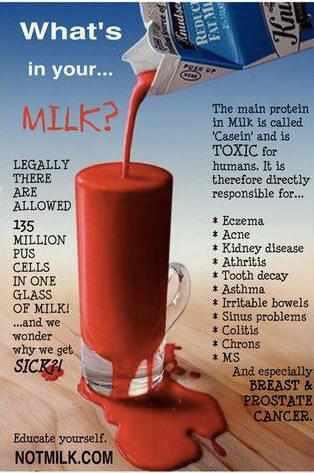
Perhaps you have read or heard that milk contains pus. Articles like this one from nutritionfacts.org have certainly played their part in spreading this myth, claiming that mastitis runs rampant in the dairy industry and that the milk from these cows is saturated with pus (along with the highly inaccurate claim that most cows are only productive for two years). http://nutritionfacts.org/2011/09/08/how-much-pus-is-there-in-milk/ Perhaps you’ve seen inflammatory infographics like this one:

A dairy friend of mine says that the NotMilk website is aptly named: it is most certainly not milk what they describe there! A dairy friend of mine says that the NotMilk website is aptly named: it is most certainly not milk what is described there! And that bit about casein: human breast milk also contains casein. It’s not likely to be deadly, is it?!

Maybe you’ve even had the dubious pleasure of watching the same video I have, where the somber voice over gleefully chortles about the millions of pus cells present in each glass of milk.


So…Is there pus in milk??? Absolutely not. As a dairy farmer, I work with our cows and their milk daily, and I know that this is not true. Allow me to explain…

Where do these rumours begin? Like all mammals, cows produce milk after giving birth. Sometimes a cow will develop an infection of the udder called mastitis. For those familiar with breastfeeding, you’ll know that humans too can develop mastitis. This accurate definition from Wikipedia sums up mastitis clearly and succinctly: “Mastitis occurs when white blood cells are released into the mammary gland, usually in response to an invasion of bacteria of the teat canal. Milk-secreting tissue and various ducts throughout the mammary gland are damaged due to toxins by the bacteria. Mastitis can also occur as a result of chemical, mechanical, or thermal injury. The udder sac is hard, tight, and firm. This disease can be identified by abnormalities in the udder such as swelling, heat, redness, hardness or pain if it is clinical. Other indications of mastitis may be abnormalities in milk such as a watery appearance, flakes, or clots.” Reading this definition, one can almost understand why a person not familiar with procedures and practices on a dairy farm could be led to believe that there is pus in milk, especially after reading false statistics claiming widespread incidences of mastitis in dairy cows. Yes, cows can get mastitis. It can be a debilitating, even life threatening infection if not treated properly and promptly. As farmers, we take each case of mastitis very seriously. When mastitis is detected, either via testing or the daily visual inspection of each cow’s milk before the milking machine is attached, the milk from that cow does not enter the supply chain until the infection has cleared. Depending on the severity of the infection, there are a few different ways to treat mastitis. If the infection is not too virulent, hot compresses and massages and stripping out the milk from the infected part of the udder can sometimes help the cow get rid of the infection on her own. Other times, antibiotic treatment is necessary. When a cow is treated with antibiotics, her milk also does not enter the supply chain and is discarded until the drug specific withdrawal time has passed. Additionally, all milk is tested on farm and at the processing plant for antibiotic residues; if residues are detected, all contaminated milk is discarded and the farmer responsible pays a hefty fine. Once a cow has recovered and her milk has tested clear of antibiotic residues, her milk is once again shipped to the processing plant.

A healthy udder on a healthy cow. No swelling, hard quarters or redness to indicate mastitis. A few squirts of milk were expressed before milking to check for irregularities in the milk. A healthy udder on a healthy cow before and after milking. No swelling, hard quarters or redness to indicate mastitis. A few squirts of milk were expressed before milking to check for irregularities in the milk. After milking, an antibacterial dip is applied to the teats to prevent bacteria from entering the open teat end.

Is mastitis rampant in the dairy industry? No! Take this blurb from the Code of Practice for the Care and Handling of Dairy Cattle: “Overall goals to strive for are: b) Reduction in the occurrence of clinical mastitis to two or fewer clinical cases per 100 cows per month.” Adherence to the Code is now mandatory on all dairy farms across Canada. These guidelines were written to be realistic and practical for dairy farms. If mastitis were rampant, aiming for an incidence level of less than 2% per month wouldn’t be feasible. We aim to reduce cases of mastitis by ensuring that our cows live in a clean and sanitary environment. We keep their stalls full of fresh, clean bedding; we clean the barns of manure multiple times per day; we utilize sanitary practices during the milking of each cow; we ensure that our milking equipment is properly maintained and serviced, and we apply an antibacterial teat protecting dip after milking when the open teat end could allow the entry of bacteria.

Now, let’s take a look at these “pus cells” that anti-dairy groups claim are in the milk you drink.

To tell you the truth, there is no such thing as a “pus cell”. Pus is made up of dead white blood cells, dead skin cells, and bacteria, not one type of cell.

So to what are these people referring? Generally, these “experts” equate somatic cells with pus cells. Somatic cells are living white blood cells located in the udder of cows. Like all white blood cells, they fight infection so an elevated somatic cell count indicates that the cow is fighting some sort of infection, such as mastitis. Milk is tested both on farm and at the processing plant, and one of the tests run is called a “somatic cell count” test. This test shows the level of somatic cells in a sample of milk. A healthy cow with no underlying infection will have a low somatic cell count (SCC). A cow with a somatic cell count below 100 000 cells per milliliter is considered to be in optimum health by most industry sources, she is not fighting any sort of mammary infection. Ontario’s Ministry of Agriculture, Food, and Rural Affairs states that “bulk tank counts or herd averages of under 200 000 indicate excellent udder health and counts over 500 000 indicate a definite problem with subclinical mastitis.” Most dairies aim to keep their SCC level under 200 000.  An average monthly herd somatic cell count under 250 000 somatic cells per mL is also eligible for a quality bonus paid to the farmer. Typically about 80% of farms in our province receive a quality bonus each month. In Canada, the maximum allowable limit for somatic cells in milk is 400 000. This line is drawn to ensure that sick cows are treated and that their milk does not enter the food chain. Consumers can rest assured that their milk does not contain pus AND that it comes from healthy cows! (Just as an aside: the somatic cell count averages for our herd over our last three SCC tests were:  142 000 (Jan 5), 147 000 (Jan 12), 163 000 (Jan 19) ).

If you are looking for answers about dairy, please be critical. Why is the source presenting this information? Is there an underlying agenda? Try to find the source of the information, and verify that it is from an unbiased agency. Pages that push vegetarian or vegan diets or lifestyles may not be interested in telling the whole truth about dairy. While some may say that this article also is a biased source of information, remember that what I have described here is supported by the scientific and veterinarian communities. You’re welcome to double check my facts!

I hope that I’ve explained this issue clearly and logically. As always, questions or comments are more than welcome in the comments section below!


Milk Myths Debunked – An Introduction

Picture this: In early December, the Farmer and I spent a few days in Vancouver attending the BC Dairy Conference. On our way into the city, we stopped at a boutique olive oil and balsamic vinegar shop. Fresh bread dipped in their balsamic and extra virgin olive oil? Ohhh my. But I digress…

While paying for my delicious finds, I asked for directions for the quickest way to our hotel. Over the course of the directions, I mentioned that we were in the city for a dairy conference. The sales lady’s eyes lit up. “Can I ask you a few questions?” she exclaimed. If you know me, you’ll know that this is what I love. Generally, my question answering is limited to social media, so a real question from (quite plausibly) one of our own consumers was overwhelmingly exciting for me. In the vehicle in front of the store, waiting for me to finish my shopping, the Farmer knew that something was up. When I get excited, as some of you who know me ‘in real life’ may know, I tend to become very animated. I gesture a lot, and I speak very quickly, probably too quickly 🙂 He could tell just by watching me that I was having a very interesting conversation.

This woman had some questions for me that I had heard multiple times on social media. Her granddaughter loves milk, but this little girl’s mother, the sales lady’s daughter, was concerned about some of the myths she had heard about milk and refused to purchase milk for her daughter. The grandmother was worried, knowing that milk consumption is a crucial part of any childhood. She explained some of her daughter’s concerns:

“Is there pus in milk?” “Is chocolate milk made from bloody milk?” “I heard that the only reason calcium is present in milk is because it is added to milk. Is this true?” “What about added hormones? Isn’t milk full of hormones?”

As I answered her questions as fully as I could given the limited amount of time we had, my mind worked furiously. I already knew that our consumers need a relevant, local source of information that they can trust about the products that we produce and they purchase, but this really brought that fact home to me. I became even more determined to do my utmost to provide access to this type of information. Before leaving, I gave her my blog address as well as our Facebook page, with an invitation to follow our postings there for information about the dairy industry.

I left that store on that cold December afternoon with a renewed feeling of purpose. Reaching customers like this, with genuine questions, brought a feeling of fulfillment. It was a great start to an amazing conference, where we learned so very much about our industry, met many industry representatives and other farmers, and enjoyed a few days away from the farm and our daily labours there.

Since that chance encounter, I’ve been mulling over how best to reach the consumers who have questions like this. I’ve finally decided to write a series of blog posts regarding the common myths about milk and milk products, starting with the most common one: Is there pus in milk? Over the next few months, I will be adding more topics to this series. As always, if you have any questions, please don’t hesitate to let me know! Additionally, your help in sharing these articles will ensure that consumers looking for answers to these questions will be more likely to find these posts. Thank you!

Supply Management Part 2: Recent Developments and Comparisons

Perhaps you’ve heard some of the latest news from New Zealand, detailing their current dairy woes. Since my last article explaining supply management was published, several readers have reached out, asking about New Zealand’s deregulated dairy industry. Long promoted as “the Miracle Down Under“, New Zealand has traditionally been held up by various anti-supply management groups and individuals as an example of how the Canadian dairy sector would prosper if our dairy industry were to be deregulated. Supply management critics purport that dairy prices for consumers would drop, but farmers would be able to compete in the world market and begin to export milk products, thus expanding the dairy sector.

Those dreams have been shattered over the past few months. Due to global issues, such as the ban on dairy products from the EU by Russia and the drop in China’s imports of skim milk powder, global milk supply has increased dramatically, causing prices to drop. The global milk price has HALVED since last February. Farmers in New Zealand now can no longer cover the cost of production by the price they are paid for their milk. Farmers are currently being paid about $0.45 per liter of milk. They are doing whatever they can to cut costs, reducing labour costs, feed costs, and lowering production. The dairy industry in New Zealand accounted for one-quarter of their exports and one-third of their economic growth last year. It’s still too early to put real numbers together, but economic experts expect that this situation will definitely negatively affect New Zealand’s economic outlook as a whole.


But what about the price consumers pay for their milk? The decreased price paid to farmers must coincide with a lower price for consumers? NO! The price of milk in New Zealand grocery stores has actually increased by 3.2% in October alone. Consumers there generally pay between $1.75 and $2.50 per liter of milk. Compare that to our price: approximately $1.48/L, which has risen at less than the consumer price index for the last 30 years, and actually dropped by 0.4% in the last fiscal year. I’ve corresponded with “Kiwi” dairy farmers who complain that consumers don’t seem to realize that the astronomical supermarket costs are not associated with the dairy farmers, who can barely scrape by, but with the processors and retailers who set whatever profit margin they desire.

I suspect New Zealand has now lost the rights to the title “Miracle Down Under”. For both their farmers’ and consumers’ sakes, I hope it doesn’t become the “Debacle Down Under”.

IMG_3633

Our 70 milk cows. 76 cow herds are the average in Canada. 98% of our dairy farms are family owned. Herd size in NZ is much higher: 393 cows on average. 25% have more than 500 cows and over 490 of these have more than 1000 cows. 65% are owner operator businesses, the rest are part share or equity partnerships.
Both Canadian dairy farmers and consumers are fortunate to enjoy a dairy industry that is strong, stable, and self reliant. Supply management benefits Canada’s economy as well as our local economies. Milk products, especially fluid milk and cream, are generally sold locally, creating local jobs and revenue. The dairy sector’s GDP contribution increased from $15.2 B in 2009 to $16.2 B in 2011, and has created thousands of jobs, increasing from 215,104 to 218,330 over the same time frame. Additionally, the dairy industry contributes more than $3B in local, provincial and federal taxes every year. A situation like the one “down under” would be disastrous to dairy farmers, would not benefit consumers, and would likely result in economic instability for the agriculture sector and quite possibly for the Canadian economy as a whole.

support Canadian dairy

I hope supply management critics and our politicians sit up and take notice: this is NOT the type of future that would be beneficial to Canadian farmers or consumers. The current Trans-Pacific Partnership trade talks are rumoured to be a threat to supply management. Our Canadian negotiators should ask themselves if the situation in New Zealand is one that Canadian voters would appreciate and support. Canada has signed other trade agreements without sacrificing supply management, and, in my opinion, these present global circumstances heavily favour retaining the current system to protect all Canadians – farmers and consumers alike. I challenge our politicians and policy makers to stand up in support of supply management because, really, in all likelihood, the future of dairy would be looking rather grim without it.

Supply Management: An Unfair Advantage or a System that Works?

If you live in Canada, chances are you’ve heard or read multiple opinions about our supply managed dairy industry. I’d like to spend some time explaining what supply management is and how I feel it benefits all Canadians – consumers and farmers alike.

Around the world, farmers face wild fluctuations in the price they are paid for the milk produced on their farms. Perhaps you’ve heard of the challenges currently facing British dairy farmers who cannot continue operations at the price they are currently paid for milk. This is not the case in Canada. Why?

In the 1960s and early 1970s, the Canadian government and Canadian dairy farmers came to the conclusion that production discipline – balancing supply and demand for milk products – was necessary to avoid extreme market fluctuations. Both the federal and provincial governments worked together with farmers to implement a system that is adjusted to suit the needs of Canadian demand for dairy. The system is administered by the Canadian Dairy Commission, which measures the demand for milk and sets the production limits accordingly. Milk found in Canadian grocery stores is solely produced by Canadian dairy farmers for Canadian consumers. Milk is a local product, supporting local economies across our nation.

The share of the market that each farm owns is called quota. Quota grants the farm a right to produce milk. The provincial quota is adjusted according to demand, and is increased or decreased as needed. Overproduction and waste are avoided because production is directly synchronized with consumer demand.

Dairy farmers are paid a standard price for the milk they produce. This price is set by the Canadian Dairy Commission and is the result of a yearly national study of the cost of producing milk at the farm. Producers are paid the cost of producing the milk they ship to the processor. However, the retail price is influenced by more than the price paid to farmers. Processors and retailers can increase or decrease the price of milk in the stores to provide what they feel is a suitable margin of profit. It is also important to note that quota ensures the price of the raw milk produced on the farm, but not the income. If a farmer cannot produce the quota of milk, no payment is received. Just as in all farming, dairy farmers can be negatively impacted by crop failures, herd illness, natural disasters, etc. Milk quota does not protect farmers from these types of problems, but farmers in a supply managed system are just as subject to regular farming woes as any farmer from any country around the world. Additionally, Canadian farmers are not subsidized in any way, as is the case in most countries.


So what’s the problem? As I mentioned earlier, there are various opinions about supply management. Critics of the system claim it makes milk products more expensive, blocks imports and is a barrier to trade. Some become rather indignant and antagonistic in their disagreement, calling supply management a “cartel of milk-fare bums receiving more than their fair share of government handouts”. Other critics complain that it is too difficult for aspiring farmers to obtain or purchase quota, making the system an “old-boys club”. Some lobby to have the industry deregulated, allowing imports from other countries to pour in. Allow me to explain why this is a terrible idea.

Incidentally, many of the arguments I mentioned are myths, not realities.

Perhaps you’ve compared the price of milk in Canada to that of milk being sold in supermarkets just across the border. Wow! It looks like the Americans are getting a much better deal on their dairy products! But wait just a minute… The price on the store shelves doesn’t tell the whole story. On average, Canadians pay $1.48/L of milk. Americans pay $1.04/L. However, you may not be aware of the fact that US farmers are government subsidized – taxpayers contribute to government funded direct and indirect subsidies paid to dairy farmers to offset the cost of production. Sources claim that an average of 24 to 37cents/L is paid to American dairy farmers, accounting for approximately 53% of the cost of producing that milk. This subsidy comes directly from American taxpayers’ pockets, and when added to the price of milk in the stores, shrinks the price difference quite dramatically. Remember this: Americans pay for their milk in the stores and through their taxes. In this source, the author, a Canadian economist, claims that Americans actually pay more for their milk when tax-payer funded subsidies are taken into account: http://www.theholmteam.ca/WDF.Holm.Oct.2014.Senator.Kenny.pdf

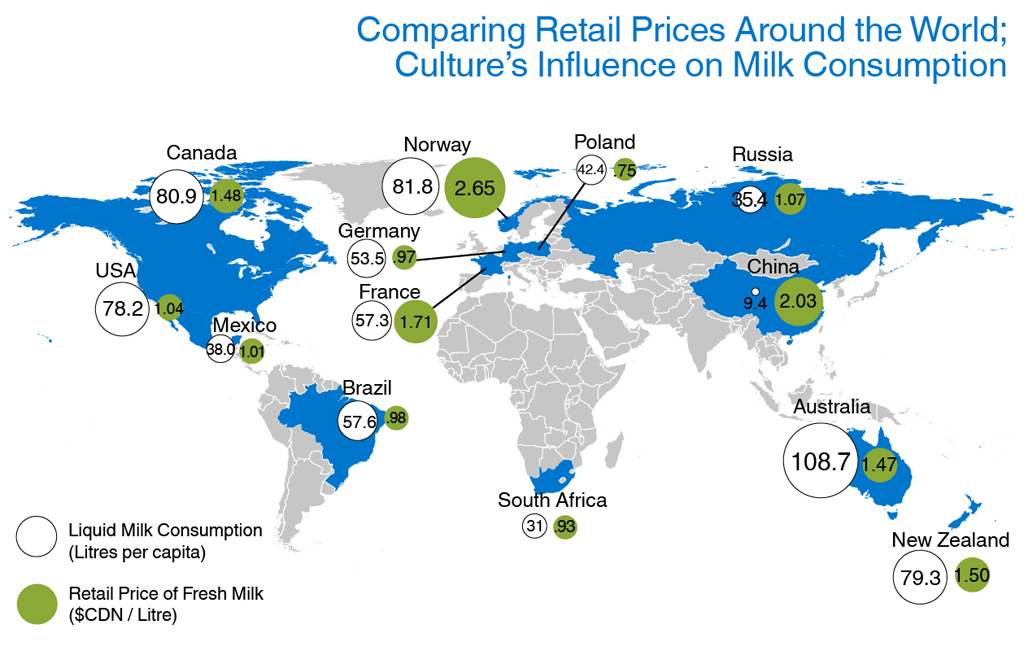
Canada’s milk price is very comparable to that of the rest of the world. The price of 1 L of milk in China in Canadian currency is $2.30, Australia: $1.47, New Zealand: $1.50, France: $1.71, Denmark: $2.65, Germany: $1.07. (To view a complete info-graphic of world milk prices, go to http://www.dairyfarmers.ca/var/df_site/storage/images/media/images/20140120_myth_milkprice-milkconsumption_1024/31299-1-eng-CA/20140120_myth_milkprice-milkconsumption_1024.jpg)

But what if the industry was deregulated? Surely that would result in lower prices for consumers, especially if farmers would no longer need to pay for costly quota to produce milk? NO! History has shown both in the UK and Australia that after deregulation, amounts paid to farmers decreased, but retail prices INCREASED! In Australia, prices for milk rose 27 cents/L in the three years after deregulation, as opposed to 9 cents/L in the three years before deregulation.


Additionally, in New Zealand, known as the most competitive milk producing country in the world, the price of milk in the stores is very comparable to here in Canada. Abolishing supply management would be extremely detrimental to farmers’ incomes and would likely result in government subsidies paid to farmers, but probably would not benefit the consumer at all.


EDIT (Dec. 10, 2014): Recently, news sources have been full of news about the milk crisis in New Zealand. Global milk prices have plunged due to  Russia blocking dairy imports from the EU and China importing less milk, both of which have led to a global surplus of milk, causing prices to halve since last February. Farmers in New Zealand are being paid less than the price of production now, BUT retail prices of milk have remained the same – higher than the prices Canadian consumers pay. At the moment, both consumers and farmers can be thankful for our supply managed system!

http://www.radionz.co.nz/news/national/256004/dairy-foods-unlikely-to-be-cheaper

http://tvnz.co.nz/national-news/concern-milk-moving-staple-luxury-6130538

http://www.radionz.co.nz/news/national/259332/fonterra-defends-rising-milk-prices

http://www.dairyherd.com/news/nz-farmers-tighten-tap-milk-production-prices-plunge


Does supply management hinder trade agreements and block imports of foreign produced milk products? NO! Since 1986, many trade agreements have been signed by Canada, including NAFTA , EFTA, and, recently, CETA. Canada is also participating in TPP (Trans-Pacific Partnership) talks. Supply management has been brought up at these agreements, but has not yet hindered an agreement’s successful completion. You may also be surprised to learn that Canada gives access to quite a slice of imported dairy products – more than 6%. Interestingly, countries that are known to be “free trade friendly”, such as the US, import less (2.75% in the US).

Of course, the cost of quota does make the process of beginning a dairy farm more difficult. In Canada, many farms are handed down though the generations, allowing the younger generation to continue on the family farm, gradually assuming the debt burden. However, most provinces have implemented an entrance program for aspiring farmers. The programs allot a certain amount of quota to farmers wishing to enter the industry, giving them a “leg up” into the industry, helping them to start out on their own. The value of the quota received is paid back over a number of years, or (in some provinces, including here in BC) belongs to the farmer free and clear after 10 years.

As you can see, many of the objections to supply management are unfounded and inaccurate. If you’d like to learn more about the system, check out these resources:

Dairy Farmers of Canada: http://www.dairyfarmers.ca

Canadian Dairy Commission: http://www.cdc-ccl.gc.ca/CDC/index-eng.php?id=3806

And, as always, if you have questions, please feel free to voice them in the comments section below.

To conclude, I’ll leave you with the voice of Canadian dairy farmers: “We support supply management… because it works!” I hope you agree.

To Milk A Cow


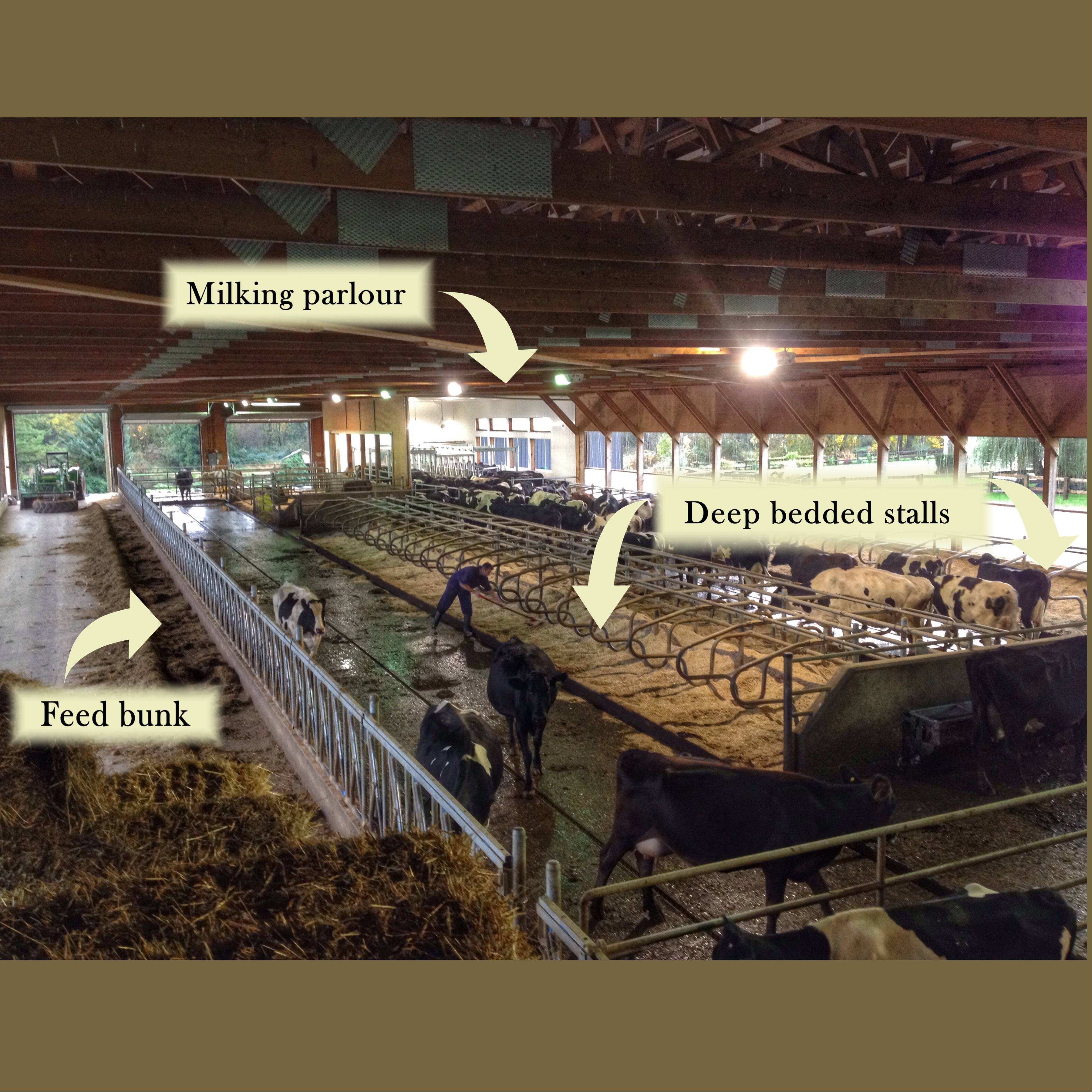
A large part of a dairy farmer’s day is spent milking the cows. Each farm in Canada follows similar procedures, and all must adhere to the regulations set out in the Canadian Quality Milk (CQM) program. On our farm, we usually milk the cows ourselves; our 70 cow milking herd is easily managed by one person. We do, however, employ a lovely young lady who milks our cows on alternating Saturday afternoons. This gives us some time to spend as a family, either around the house or occasionally taking day trips together. We milk twice a day – beginning at 5:30 am and 5:00 pm – and each milking takes about one hour, excluding the associated chores, such as feeding calves and heifers. It takes about 8 minutes to milk each cow, some shorter, some longer. Each side of our milking parlour (the place where the cows are milked) accommodates 8 cows, so 16 cows are milked at once. The rest of the day, our cows are free to roam about the barn, socialize with other cows, lie down in the comfy sawdust bedded stalls, munch on their specialized ration of feed at the feed bunk or head out to pasture during the growing season.

We’ve compiled a few photos recently that document our milking procedures. Enjoy!

to milk a cow barn layout

Near milking time, the cows start to gather around the milking parlour, eagerly anticipating the moment that we will open the gate allowing them access to the parlour. About half an hour before we are scheduled to milk, the parlour equipment that comes into contact with the milk is automatically washed and sanitized. This ensures that the equipment is sterile before contact with milk, keeping it safe for consumer consumption. Of course, milk is also pasteurized at the processing plant to totally eliminate the chance of milk-borne bacteria making a consumer ill. Once the gate is opened, the cows amble into the parlour. We always treat our cows gently and calmly, but this is especially important at milking time. Cows that are stressed or agitated will not allow their milk to drop, stress and agitation can block the milk let-down reflex. A cow that is not milked out properly will experience pressure and fullness in her udder before she is due to be milked again. Repeated episodes of improper milking may lead to an infection of the udder, mastitis. Therefore, both we and our employee know that cows must be handled in a calm and quiet manner during milking. Our cows are accustomed to our parlour layout, and align themselves at a 45 degree angle to the parlour pit. Our parlour is laid out in para-bone style, a cross between parallel (milking between the back legs) and herringbone (milking from the side of the cow) styles. We attach the milking unit between the cow’s hind legs. When the cows have all moved over into the waiting area in the alley behind the milking parlour, we take a scraper and clean the manure or wet sawdust out of each stall, and spread more sawdust from the pile at the front of the stall into the area where the cows lie. We want our cows to be comfortable while they’re lying down producing more milk, and overall cow health is improved when cows lie comfortably as well.to milk a cow 213

Once all 8 cows have positioned themselves properly, the back gate is closed and the brisket bar at the cows’ chest height moves in toward the parlour pit, ensuring that the cows cannot move around too much and possibly injure themselves or their neighbor. We designed special water troughs on the brisket bar that are filled with lukewarm water from the plate cooler (the plate cooler quickly cools the milk before it is pumped to the bulk tank). The girls often enjoy slurping down some liquid as they are being milked. Many cows also contentedly chew their cud while being milked; the milking process is comfortable, even pleasurable for a dairy cow.to milk a cow front and hind view

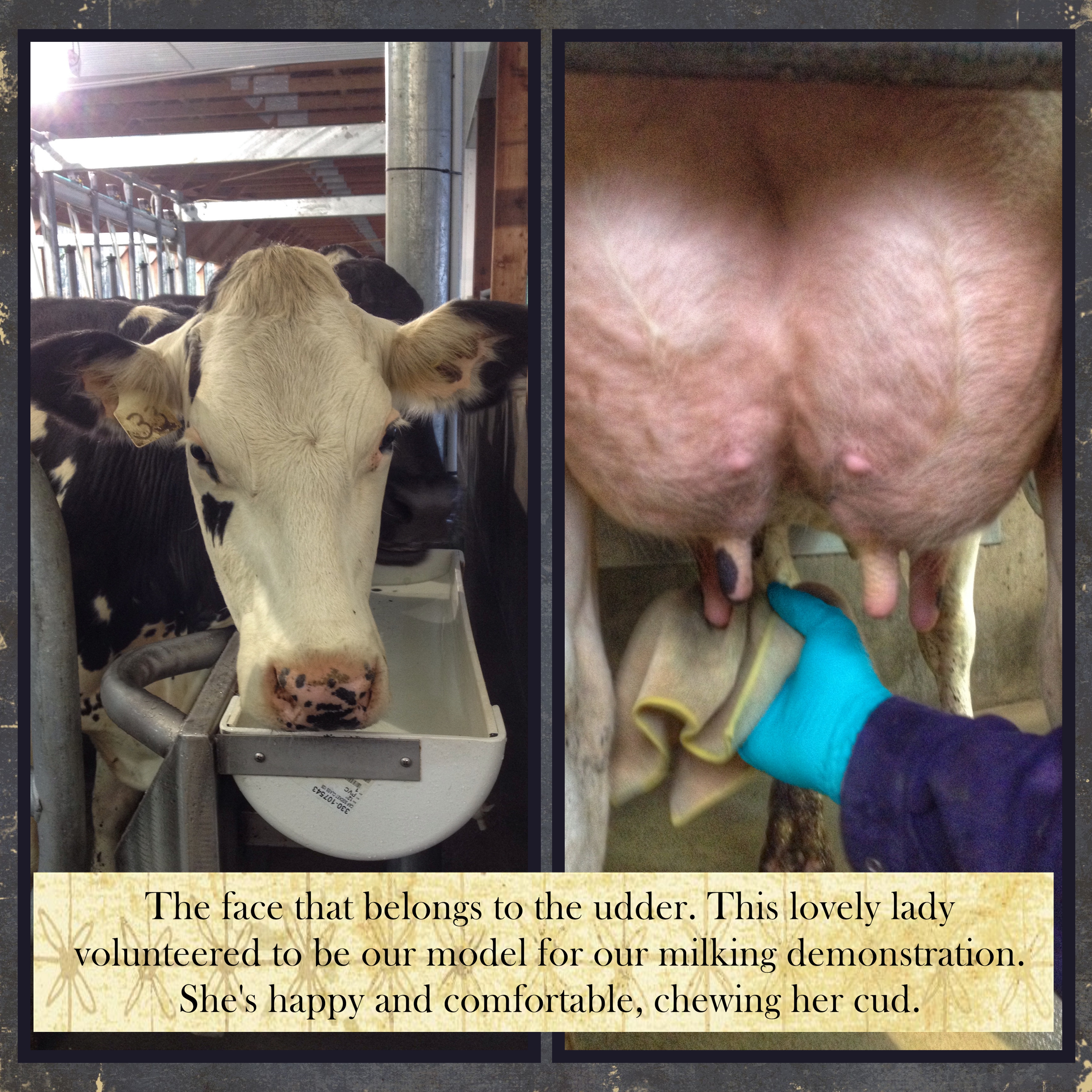
Before a cow can be milked, her udder and teats must be cleaned of manure splatters and sawdust shavings. We use soft microfiber cloths for this (see photo above). The gentle process of cleaning the udder also stimulates milk production. Some farms also use a pre-dip that disinfects the teats. We have had great success with just using our towels. Notice on the photo above that the cow’s udder is relatively clean. We take care to ensure that our cows’ stalls are free from manure and that the walking surfaces of the barn are scraped multiple times per day. As a result, less manure is present on the udder, making the pre-milking cleaning much easier. A clean udder also results in more sanitary milk.

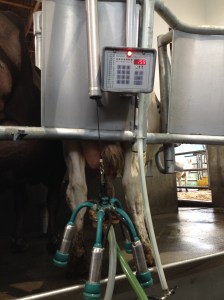
After waiting a few moments after wiping to allow the cow to get into the “milking moooo-d”, we attach the milking unit. A milking unit claw has 4 attachments – a specialized cup fitted with a soft, flexible rubber inflation – that are attached to each teat on the udder. Our units only produce suction when they are held upright. This eliminates the chance of manure or urine being drawn into the milking equipment should the cow kick off the machine or if it should fall to the ground. The suction produced is gentle but insistent, mimicking the actions of a calf’s mouth as it suckles from a teat. Milk begins to flow into the inflation, through the pipes to the plate cooler, then onto the bulk tank. If, for some reason, a cow has been treated with antibiotics, the hoses linking the milking unit to the pipeline that connect to the bulk tank are removed, and the milk is collected in a large bucket and discarded until the required withdrawal time has passed. The withdrawal time is drug specific, and is the period of time necessary for the last residues of the drug to be excreted from the cow’s system. Milk is tested on farm and at the processing plant to ensure that no antibiotic residues are present in milk. If the milk tested is found to contain antibiotic residues, the whole truck load of milk will be discarded and the farm responsible must pay a hefty fine.to milk a cow attaching milker

It usually takes about 5-10 minutes for each cow to finish milking. Once the sensors in the milking unit register that milk has stopped flowing, the milking unit automatically detaches from the udder. Each milking unit also measure how much milk each cow produces. This cow produced 15.9 liters at this particular afternoon milking. Cows generally produce a little more milk in the morning. This cow produces about 34 L of milk daily. Brown Swiss and Brown Swiss cross bred cows generally produce a little less milk than their Holstein counterparts, but the butterfat and protein components in their milk are higher. Our herd average butterfat currently is 4%, and the protein content is as 3.46%.IMG_3614

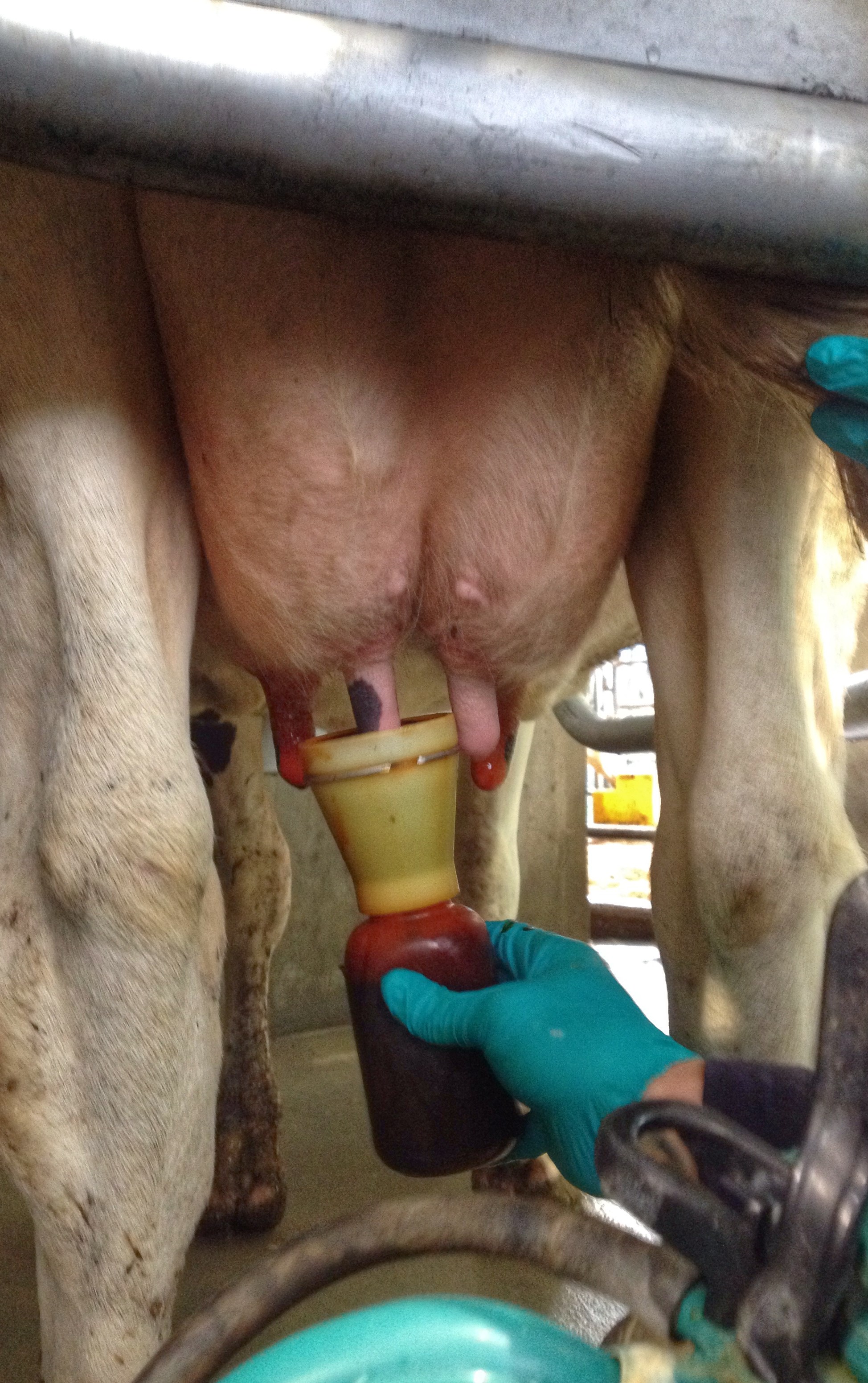
After the machine detach, each teat is dipped in an iodine solution. The iodine helps to ensure that no bacteria will enter the still slightly open teat end, and also conditions the skin of the teat, keeping it smooth and supple, free of cracks and dryness.

IMG_3639

In the photo below, you can notice the difference in udder size, comparing before and after the cow has been milked. to milk a cow before and after

Once the entire row of cows has finished milking and all of the teats have been post-dipped, the front gate of the parlour is opened and the cows can return to the barn. The cows all head over to the feed bunk to enjoy a meal of their specially prepared mixed ration. After all, producing milk works up a good appetite!

IMG_3633

When the entire herd has been milked, the manure piles are scraped away and the parlour floors, wall, and equipment are thoroughly sprayed down with a high pressure hose. The milking equipment is sanitized and washed once again. The milk in the bulk tank is cooled and stirred until the milk truck comes to pick it up and delivers it to the processor. From there, it is pasteurized and packaged and sent to local grocery stores for consumer enjoyment.

IMG_3636

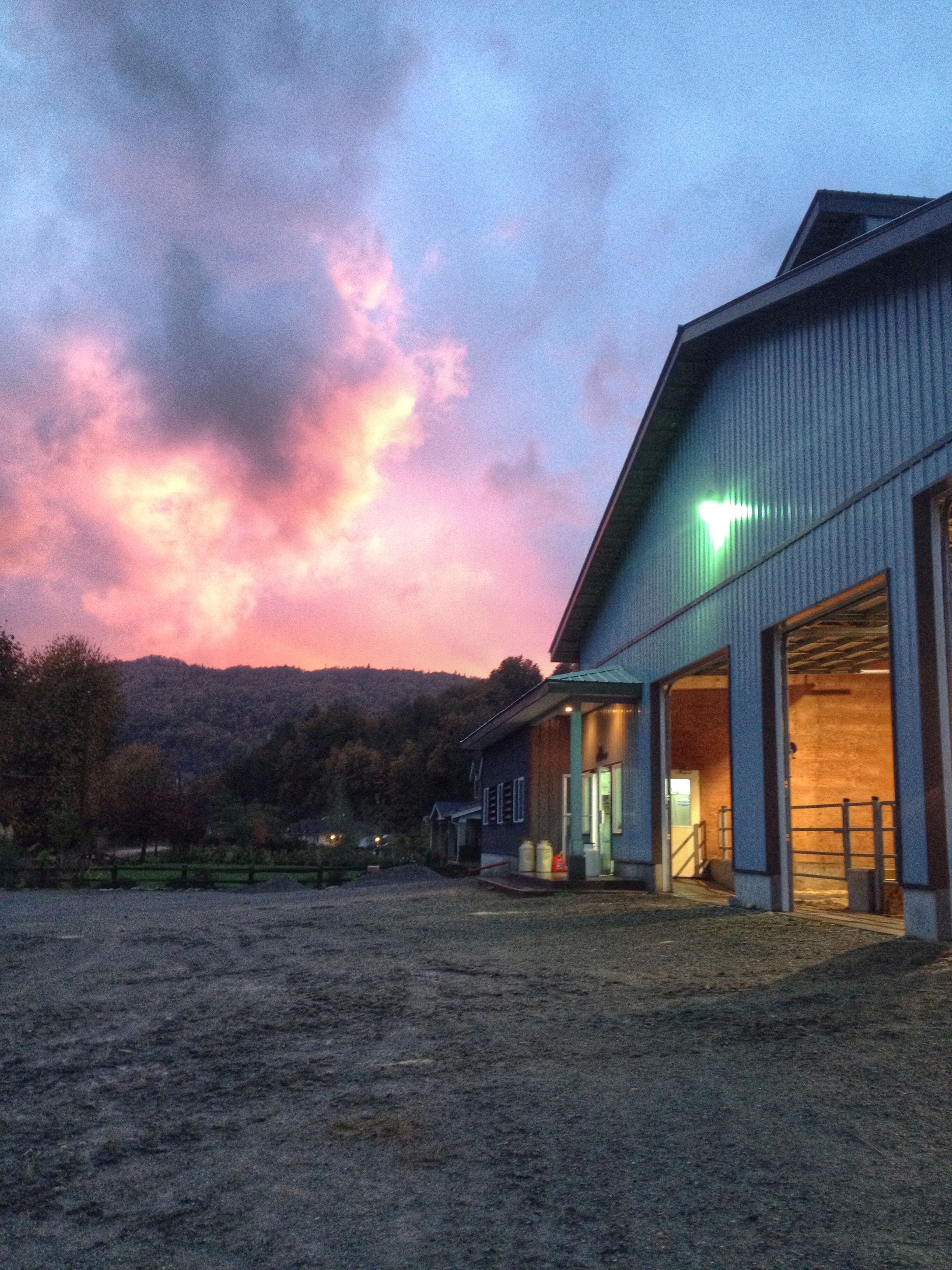
After we feed the calves warm milk in bottles and nipple buckets, we check the other young stock to be certain they also have enough food and are comfortable, then finally head into the house for our own dinner. And on some nights, we’re lucky enough to enjoy a view like this:

IMG_3632

Now, the next time that you enjoy a glass of cold milk, a wedge of cheese, a serving of yoghurt, you’ll know exactly how the product you are enjoying was supplied by cows like ours to satisfy your hunger and cravings. And so, our girls and our family would just like to say: “You’re Welcome!”